

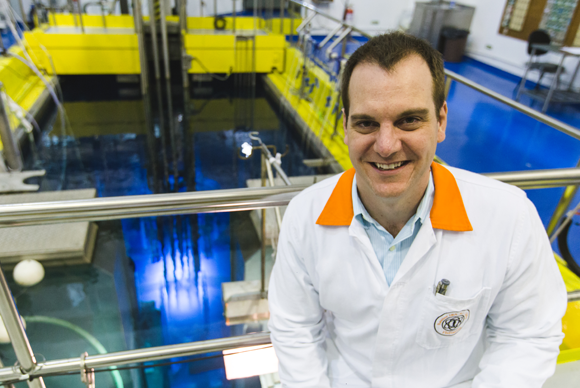
Who Am I?
Dr. Fernando Bardella is a global technology executive, scientist, and interdisciplinary researcher whose work connects digital transformation, scientific innovation, and applied technology.
He holds a Doctor of Science degree from IPEN/USP, an MBA in Project Management, and undergraduate degrees in Computer Science and Physics. His multidisciplinary background supports a career built across science, technology, and business leadership.
Fernando’s experience spans both academia and industry. In research, his work includes scientific visualization, interactive computing, immersive technologies, rapid prototyping, and digital tools for education and discovery. In industry, he has led technology, digital transformation, data, and innovation initiatives in complex and highly regulated environments, helping organizations translate strategy into scalable execution.
His professional perspective is shaped by the belief that technology should not only be advanced, but also useful, human-centered, and capable of delivering measurable impact. This approach has allowed him to work across disciplines, functions, and cultures, building bridges between research, innovation, and operational reality.
At GVCM, Fernando contributes to initiatives that combine scientific visualization, computing, and emerging technologies to improve understanding, learning, and innovation. His work reflects a continuous commitment to interdisciplinary collaboration and to connecting academic insight with real-world application.
Some of my highlights
- Founding Member and Researcher of the Group for Scientific Visualization in Materials (GVCM)
- Founder and Head of IT Innovations of GVCM’s Disruptive Technologies Lab (DTL)
- Co-Founder, Member of the Scientific Board NucleAI
- Associate Editor of the Journal of Materials Education (JME)
- Member of the International Council on Materials Education (ICME)